



Quick Summary
A basic home gym setup for HIIT needs only a clear floor space of about two by two metres, a non-slip mat, and a timer, with resistance bands and a skipping rope for variety. Weighted gear such as an adjustable dumbbell pair or a kettlebell can be added once the basics work. Upgrade only the piece that limits your sessions.
- Minimal setup: a non-slip mat, resistance bands, a skipping rope and a timer.
- Measure clear floor space before buying, since different movements need different clearance.
- One adjustable dumbbell pair or one kettlebell covers most weighted intervals.
- A typical starting structure is 40 seconds of work to 20 seconds of rest, for four to six rounds.
- Add a round before adding load, and add load only when every rep stays clean.
Table of Contents
- What HIIT Gear You Actually Need at Home
- Equipment Tiers by Budget and Available Space
- Bodyweight Setup: Zero-Equipment HIIT Essentials
- Best Equipment for HIIT at Home with Weights
- HIIT Exercises at Home with Weights and Low-Impact Swaps
- Home Gym Setup for Beginners: Step-by-Step
- Safety, Floor Protection and Gear Maintenance
- Choosing Your First Training Gear Kit
- Frequently Asked Questions
What HIIT Gear You Actually Need at Home
High-intensity interval training works with almost no equipment, which is why the question of gear matters more than most people think. Most home HIIT programs need only a few well-chosen items, and buying too much is the fastest way to waste money on kit that gathers dust.
The core of a useful home setup is a clear floor space, a non-slip mat, and one or two loadable tools for variety. Add a timer, and you have everything required to run structured intervals. Everything beyond that is an upgrade, not a requirement.
Equipment Tiers by Budget and Available Space
Not every home has room for a squat rack, and not every budget stretches to a commercial-grade bike. Sorting equipment into tiers by footprint and outlay makes the decision concrete rather than aspirational. The tiers below assume a typical spare-room or garage setup; adjust the floor area to your own space before buying.
Tier 1: Minimal space, low outlay (under roughly 2 square metres, under about $150 AUD)
- Non-slip exercise mat (about 6 mm thick for floor work and joint cushioning)
- Set of loop resistance bands (light, medium, heavy)
- Skipping rope
- Interval timer app on your phone, or a basic stopwatch
This tier covers bodyweight circuits, band-resisted movements and rope intervals. It suits apartments, shared rooms and anyone testing whether HIIT will stick before spending more.
Tier 2: Small room, moderate outlay (about 4 to 6 square metres, roughly $300 to $800 AUD)
- Adjustable dumbbell pair, or one or two kettlebells in a weight you can press and swing with clean form
- Medicine ball (4 to 6 kg is a practical starting point for slams and rotations)
- Stability ball
- Slam mat or thick interlocking floor tiles under the weighted work
Tier 2 adds load and variety without a permanent footprint.
Tier 3: Dedicated space, higher outlay (8 square metres or more, roughly $1,500 AUD and up)
- Cardio machine (rowing machine, air bike or compact treadmill)
- Adjustable bench
- Power rack or squat stand with bumper plates
- Dedicated flooring and storage
Tier 3 only makes sense when you have a room you can leave set up and a training habit already established. A power rack and bumper plates are excellent for strength-biased intervals, but they are a poor first purchase if you have not yet confirmed you will train at home consistently.
Choosing between tiers
Match the tier to your goal and constraint rather than to a wish list:
- Conditioning focus, limited space: Tier 1 plus a skipping rope or a compact rower if floor space allows.
- Strength-biased intervals: Tier 2 adjustable dumbbells or kettlebells, then Tier 3 plates and a rack once load becomes the limiting factor.
- Low-impact training: Tier 1 bands and mat, plus a rower or bike at Tier 3 if budget and space permit.
- Apartment or shared floor: stay at Tier 1 and choose quiet movements; skip anything that generates impact noise.
A common mistake is jumping straight to Tier 3 before mastering Tier 1 movements. Start where your space and budget allow, then add equipment only when your workouts have outgrown what you own. If a piece of gear has not been used in a month, that is the signal to stop upgrading and reassess what your sessions actually need.
The three equipment tiers differ mainly in floor space and cost, as summarised below.
| Tier | Space needed | Approximate cost (AUD) |
|---|---|---|
| Tier 1: Minimal | Under roughly 2 square metres | Under about $150 |
| Tier 2: Small room | About 4 to 6 square metres | Roughly $300 to $800 |
| Tier 3: Dedicated space | 8 square metres or more | Roughly $1,500 and up |
Bodyweight Setup: Zero-Equipment HIIT Essentials
Bodyweight training is the cheapest way into HIIT, and it is more demanding than most people expect.
A basic 20-second work, 10-second rest structure works well with no equipment at all. Repeat the circuit for four to six rounds and progress by shortening rest or adding a movement.
You only need a mat for floor work and a clear space about two metres square. That is enough for a complete session, and it suits apartments where noise and space are real limits.
Best Equipment for HIIT at Home with Weights
Weighted equipment adds resistance to interval work, which builds strength alongside conditioning. The selection principle is simple: choose items that let you change load quickly, because moving between exercises should not mean a long break. The comparisons below use four criteria that matter in a home setting, footprint, versatility, outlay and noise.
Adjustable dumbbells versus fixed dumbbells
Adjustable dumbbells are the most space-efficient option for most home setups. A single adjustable pair can replace a full rack of fixed weights, and it works across squats, presses, rows and swings. The trade-off is changeover time: dial or pin systems take a few seconds per adjustment, which is fine between rounds but disruptive mid-interval. Fixed dumbbells are faster to grab but consume far more floor space and cost more once you own several pairs.
- Footprint: adjustable pair roughly 0.5 square metres; a rack of fixed pairs several times that.
- Versatility: adjustable wins for progressive loading; fixed wins for speed of use.
- Outlay: a single adjustable pair typically costs less than three or four fixed pairs covering the same load range.
- Noise: both are quiet on a mat; dropped weights are the noise risk, not the dumbbells themselves.
Kettlebells for interval work
Kettlebell swings and thrusters are staples of weighted HIIT. A single kettlebell covers most of the posterior-chain and full-body movements you need, and it stores in a corner. Dumbbells offer more flexibility for unilateral work like alternating lunges and single-arm rows, so the practical answer for many homes is one kettlebell plus one adjustable dumbbell pair.
Pick a weight that lets you complete every rep with clean form for the full work interval. If form breaks down before the timer ends, the load is too heavy for interval training.
Resistance bands, medicine balls and cardio options
Resistance bands are light, cheap and surprisingly effective for interval work, particularly for band-resisted squats and lateral walks. They store easily, which makes them ideal for small spaces, and they are the quietest option on this list.
Shred Cartel Base Shorts – Black →
Medicine balls suit slam-ball and rotational exercises, and they are safe for most home floors when used with a suitable slam mat.
For cardio, a skipping rope or a compact rowing machine delivers strong intervals without much floor space.
Structuring weighted intervals and progressing
A simple structure that works with any of the above is 40 seconds of work to 20 seconds of rest, repeated for four to six rounds per circuit, with 60 to 90 seconds between circuits. Progress in this order:
- Add a round before adding load.
- Shorten rest before adding load.
- Add load only when every rep in every round is clean.
This sequence keeps the conditioning stimulus ahead of the strength stimulus, which is the point of weighted HIIT. If you find yourself needing long breaks to complete the work, the load or the round count is too high for the session's purpose.
HIIT Exercises at Home with Weights and Low-Impact Swaps
Weighted HIIT can follow a simple rotation: one lower-body, one upper-body and one full-body move per round. This keeps the session balanced and stops any single muscle group from fatiguing too early.
Low-impact swaps keep the intensity high without jarring the joints. Step-back lunges replace jump lunges, and kettlebell swings can replace jump squats. Adjusting the movement rather than cutting the session is the better choice for knees, hips and lower backs.
Home Gym Setup for Beginners: Step-by-Step
A functional home gym setup for beginners takes about an afternoon. The steps below keep the process practical.
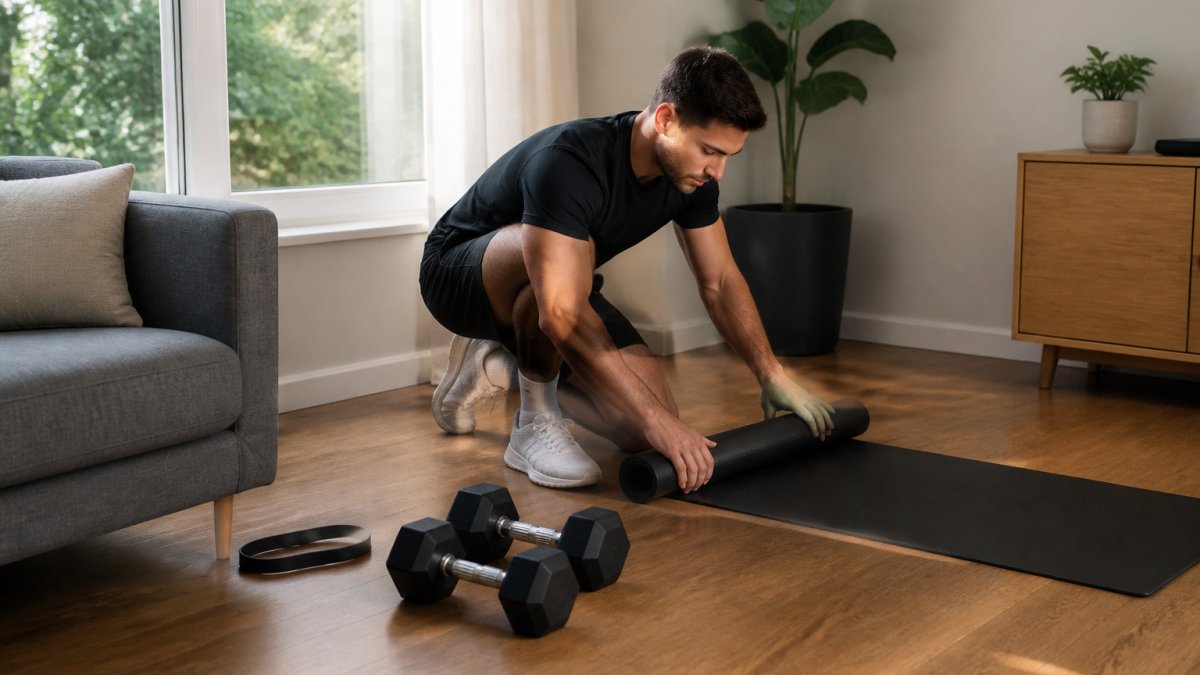
- Clear a space of about two by two metres, free of furniture and tripping hazards.
- Lay a non-slip exercise mat over hard flooring to protect both the floor and your joints.
- Add one loadable tool, usually an adjustable dumbbell pair or a kettlebell, sized to your current strength.
- Add resistance bands and a skipping rope for variety and cardio.
- Set up a timer, either a stopwatch or an interval app, so you can run work and rest periods accurately.
- Test a 20-minute session and note which movements feel limited by space or equipment.
Once this baseline works, upgrade only the piece that limits your sessions. This keeps spending tied to real need.
Safety, Floor Protection and Gear Maintenance
Home HIIT carries specific risks: slips on bare floors, dropped weights on flooring, and overheating during long sessions. A thick mat, a clear landing zone and a fan or open window cover most of these.
Shred Cartel's Base Shorts have a 5-inch athletic length and a bamboo blend fabric that is soft and breathable. Explore sweat resistant gym wear for men that holds up through heavy training. They are designed to sit snug against the thighs and not ride up during workouts.
Maintain your gear to extend its life. Compare breathable workout gear for summer to stay cool and dry through hot sessions. Wipe down mats and kettlebells after sessions, store bands away from direct sunlight, and check straps and stitching regularly. Find out whether tumble drying ruins gym gear.
Choosing Your First Training Gear Kit
For most people starting out, a sensible first kit includes a non-slip mat, a set of resistance bands, a skipping rope, and one adjustable or fixed-weight dumbbell pair. This combination covers bodyweight, weighted and cardio intervals for under most home-gym budgets.
Choose apparel that matches your intensity. Learn how to keep resistance bands and gym gear elastic and in good condition.
Start with the kit, run your sessions consistently for a month, and then decide what to add. The best home gym is the one you actually use.
Frequently Asked Questions
What equipment do I need for HIIT at home?
Most people can start HIIT at home with a non-slip exercise mat, a pair of adjustable dumbbells or a single kettlebell, and a set of resistance bands. Bodyweight moves such as burpees, squat jumps and mountain climbers need no equipment at all. Add a jump rope if you want an inexpensive cardio option. Prioritise gear that lets you change exercises quickly, because variety keeps intervals challenging and reduces boredom over a 12-week block.
Can I do HIIT at home without equipment?
Yes. A complete HIIT session can be built from bodyweight exercises alone, including squat jumps, push-ups, alternating lunges, plank shoulder taps and burpees. Work in intervals such as 30 seconds on and 30 seconds off, then progress by shortening rest, adding reps or extending the work period. Equipment adds load and variety, but it is not required for an effective session.
How much space do I need for a home HIIT setup?
A clear area roughly 2 metres by 2 metres is enough for most HIIT circuits, including burpees and lunges. Thrusters and kettlebell swings need a little more overhead and side clearance, so check the ceiling height before buying anything tall. Compact options such as folding benches, wall-mounted bands and stackable plates let you fit a useful setup into apartments and shared spaces.
Are dumbbells or kettlebells better for home HIIT?
Both work well, and the better choice depends on your goals. Kettlebells suit swings, snatches and carries, which are powerful and efficient for full-body intervals. Dumbbells offer more control for lunges, thrusters and presses, and adjustable sets save significant space. Many home trainees pair one of the two with resistance bands to cover a wide range of movements on a limited budget.
