


Table of Contents
- What Makes Workwear Actually Durable
- Breathability, Moisture Management and Mobility
- How to Prevent Fabric Pilling on Gym Shirts
- The Best Organic Cotton Workwear for Men Who Train Hard
- How to Care for High-Performance Work Clothing
- What Durable Workwear for Active Men Costs
- Frequently Asked Questions
Last Updated: September 18, 2026
What Makes Workwear Actually Durable
Durable workwear for active men comes down to two things: fabric weight and how the garment is put together. Everything else, colour, fit, branding, matters less once a seam blows out three months in. At Shred Cartel, we build gear around that premise, because a shirt that fails at the shoulder seam is useless no matter how good it looked on day one.
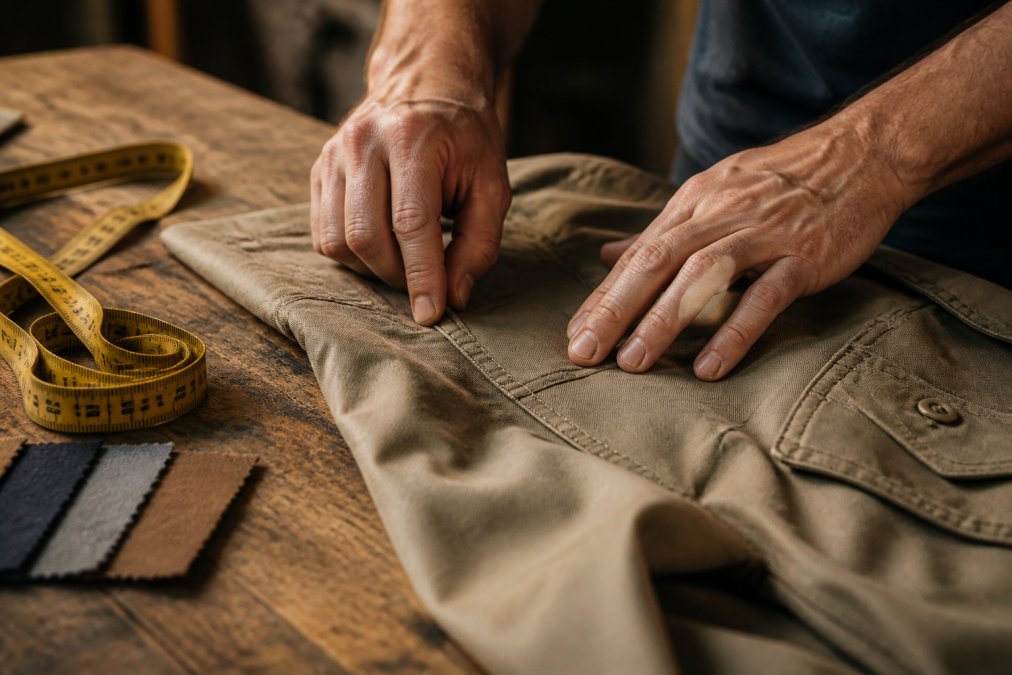
Close-up of hands inspecting the reinforced double-stitched seam of durable workwear on a timber workbench.
Fabric weight and weave: where longevity starts
Fabric weight is measured in GSM (grams per square metre), and it tells you how much material you're getting per square metre. A 280 GSM cotton blend holds its shape through repeated washing far better than a thin 150 GSM alternative, which tends to stretch, sag and thin out at stress points.

Unisex oversize T-shirts - Black
Stitching, seams and reinforcement points
The seams are where workwear fails first. Double-stitched or bar-tacked construction at high-stress points (shoulders, crotch, pocket corners, belt loops) is the difference between a garment that lasts two years and one that lasts six months.
Breathability, Moisture Management and Mobility
Breathable workwear moves sweat away from your skin instead of trapping it against your body. That matters whether you're on a job site in January heat or mid-set on your fifth exercise. A moisture-wicking fabric pulls perspiration to the surface where it evaporates, while a non-breathable one leaves you damp, heavy and chafing.
How to Prevent Fabric Pilling on Gym Shirts
Fabric pilling happens when short fibres work loose from the weave, tangle together and form those small balls on the surface. It's accelerated by friction, heat and rough washing. The fix is partly about what you buy and partly about how you treat it.
Why some fabrics pill and others don't
Pilling is a fibre-length problem before it's a washing problem. Short-staple fibres, the kind found in cheaper cotton and low-grade polyester blends, have more loose ends per square metre, and every loose end is a potential pill. Longer-staple fibres, such as combed or ring-spun cotton, sit flatter in the yarn and have fewer exposed ends to tangle.
The washing routine that actually slows pilling
- Turn garments inside out before washing to protect the outer surface
- Wash in cold water on a gentle or sport cycle
- Use a mild detergent, never fabric softener, which coats fibres and kills breathability
- Skip the dryer or use the lowest heat setting
- Air dry in shade to prevent UV fading
- Wash separately from towels, denim and anything with zips or Velcro
- Treat stains promptly rather than letting them set
Heat is the single biggest accelerant. A hot wash and a hot dryer weaken the fibre structure, so the same shirt that survives 50 cold washes may start pilling after 10 hot ones. If you must use a dryer, choose the lowest heat setting and pull the garment out slightly damp.
Repairing pills without wrecking the garment
If a shirt already has pills, a fabric shaver or a fine-toothed comb removes them without cutting into the weave. Work in short strokes over a flat surface, and don't press hard, the goal is to lift the pills, not to shave the fabric itself. A pumice stone or a clean razor used gently does the same job in a pinch.
Patching and reinforcement: the longevity habit most buyers skip
Prevention is cheaper than replacement, but reinforcement is cheaper still. A few minutes with a needle and a patch can add a year to a garment that's starting to thin at the knees, elbows or pocket corners.
- Reinforce high-wear points before they fail. A line of zigzag stitching over a thinning knee or pocket corner costs nothing and stops a small wear spot becoming a tear.
- Patch from the inside where possible. An internal patch spreads load across the surrounding fabric and is far less likely to peel than an external iron-on.
- Match the patch fabric to the garment. A stretch patch on a stretch garment moves with it; a rigid patch on a stretch garment will pull away at the edges.
- Keep a small repair kit, needle, thread, a couple of patches and a seam ripper, in your gym bag or toolbox. The repair you do the day you notice the wear is the one that lasts.
The Best Organic Cotton Workwear for Men Who Train Hard
The best organic cotton workwear for men who train hard combines certified organic fibres with enough stretch and weight to survive daily abuse. Organic cotton is grown without synthetic pesticides, and certification bodies verify that claim through the supply chain rather than taking a brand's word for it.
What 'organic' actually certifies
In Australia, organic cotton claims are verified through third-party certification schemes rather than self-declaration. The two you'll see most often on workwear labels are:
- Global Organic Textile Standard (GOTS), covers the entire textile supply chain, from fibre through to finished garment, and sets limits on chemical inputs, wastewater treatment and social criteria. A GOTS label means the garment, not just the fibre, meets the standard.
- Organic Content Standard (OCS), verifies the presence and percentage of organic fibre in a product but doesn't cover processing chemicals or social criteria the way GOTS does.
Why pure cotton struggles in active workwear
Pure cotton has one weakness: it holds moisture. Cotton fibres swell when wet, which is why a soaked cotton tee clings, chafes and takes hours to dry. For a job site in January heat or a heavy training block, that's a real problem, wet fabric against skin accelerates chafing and drops your core temperature once you stop moving.
Blends worth knowing
Garment |
Fabric Blend |
Weight |
Best For |
|---|---|---|---|
Iconic Singlet |
67% bamboo, 28% cotton, 5% elastane |
Lightweight |
Training, summer, layering |
Base Shorts |
67% bamboo, 28% cotton, 5% Lycra |
Mid-weight |
Gym, walking, daily wear |
Oversized Tee |
67% bamboo, 28% cotton, 5% Lycra |
280 GSM |
Everyday wear, streetwear |
Shred Cartel's range is built on exactly this principle. The Iconic Singlet uses a 67% bamboo, 28% cotton and 5% elastane blend that stays lightweight and breathable through heavy sessions. The Base Shorts apply the same blend with durable stitching and a squat-proof, non-ride-up fit. For layering, the oversized tees run at 280 GSM and resist shrinking even after machine washing and drying.


The sustainability angle most workwear pages ignore
Durability and sustainability are the same argument told two ways. A garment that lasts three years instead of six months uses a fraction of the water, energy and fibre of the three or four replacements it displaces. That's the honest case for buying better workwear: the greenest shirt is the one you don't have to replace.
How to Care for High-Performance Work Clothing
High-performance work clothing lasts longer when you wash it less aggressively and dry it more carefully. Most premature wear comes from the laundry, not the job. Cold water, gentle cycles and air drying will roughly double the useful life of a good garment.
- Turn garments inside out before washing to protect the outer surface
- Wash in cold water on a gentle or sport cycle
- Use a mild detergent, never fabric softener, which coats fibres and kills breathability
- Skip the dryer or use the lowest heat setting
- Air dry in shade to prevent UV fading
- Wash separately from towels, denim and anything with zips or Velcro
- Treat stains promptly rather than letting them set
Fabric softener is the most common mistake with technical workwear. It leaves a waxy residue that blocks moisture-wicking and traps odour, which defeats the entire purpose of the fabric you paid for.
What Durable Workwear for Active Men Costs
Expect to pay more per garment for genuinely durable workwear, and expect to buy it less often. A cheap shirt replaced three times a year costs more than a well-made one that lasts three years, even before you count the frustration.
Frequently Asked Questions
What features make workwear truly durable for high-intensity movement?
Look at four things: fabric weight and weave, seam construction, stretch recovery, and reinforcement at stress points. Heavier weaves resist abrasion better, while bar-tacked or double-stitched seams stop blowouts at pockets and crotch lines. Four-way stretch fabric that snaps back to shape handles squats, lunges and overhead work without sagging. Bamboo-cotton-Lycra blends, like the 67% bamboo, 28% cotton, 5% Lycra used in Shred Cartel gear, combine softness with enough recovery to survive repeated washing and heavy training.
How does organic fabric compare to synthetic blends for workwear longevity?
Synthetics often win on pure abrasion resistance, but they hold odour and can pill quickly when rubbed against rough surfaces. Organic bamboo and cotton blends breathe better, feel softer against the skin, and hold their shape when the knit includes a small amount of Lycra or elastane. The trade-off is drying speed, so a sweat-resistant finish and proper washing matter more. For men splitting time between a job site and the gym, a quality organic blend usually outlasts cheap polyester because it resists the pilling that makes gear look worn out.
What is the best way to maintain workwear to ensure it lasts longer?
Wash inside out in cold water on a gentle cycle, use half the usual detergent, and skip fabric softener because it coats fibres and traps odour. Air dry in shade where you can, since heat breaks down elastane and shrinks cotton. Turn garments inside out before washing to reduce surface abrasion, and separate workwear from items with zips or velcro that snag fabric. Rotating two or three pieces rather than wearing one daily gives fibres time to recover, which noticeably extends the life of high-performance work clothing.
Can workwear be both professional and suitable for an active lifestyle?
Yes, and the gap has narrowed a lot. Clean lines, minimal branding and structured fits let a piece move from a job site to the gym to a coffee run without looking out of place. Shred Cartel's oversized tees in black or charcoal, for example, use a 280 GSM organic blend that holds its shape and looks sharp enough for everyday wear. Choose neutral colours, avoid loud logos, and prioritise fabric that resists odour so you can wear it more than once between washes.
The real challenge with durable workwear isn't finding something that looks tough on day one, it's finding gear that still performs after a year of heavy use. That's the standard Shred Cartel builds to: certified organic fabric blends, reinforced stitching and sweat-resistant materials designed to hold up through intense training and everyday wear. Browse our collections and gear that's engineered to last, not just to sell.