


Table of Contents
- What You'll Need Before You Start
- How to Wash Organic Cotton Activewear: Step-by-Step
- How to Remove Sweat Stains From Cotton
- How to Wash Gym Clothes to Remove Odour
- Best Eco-Friendly Laundry Detergent in Australia
- Common Mistakes That Shrink and Age Organic Cotton
- Repair and Mending: Make Your Activewear Last Longer
- Conclusion
- Frequently Asked Questions
Last Updated: September 21, 2026
What You'll Need Before You Start
Washing organic cotton activewear the right way starts with three things: a gentle detergent, cold water, and patience. Get those right and your gear holds its shape for years instead of months.
At Shred Cartel, we build our pieces from a certified organic fabric blend. Here's what to gather before you wash organic cotton activewear:
- An enzyme-free, biodegradable detergent (more on this below)
- A mesh laundry bag for smaller items
- A drying rack or clothesline
- White vinegar for odour and stain treatment
- A stain cloth or soft brush for spot cleaning
Skip the fabric softener and bleach. Both break down natural fibers faster than regular wear ever will.
How to Wash Organic Cotton Activewear: Step-by-Step
The short version: cold water, gentle cycle, low spin, air dry. That combination protects fiber integrity better than any single product you can buy. But the details inside each step are where most people go wrong, so here is the full sequence.
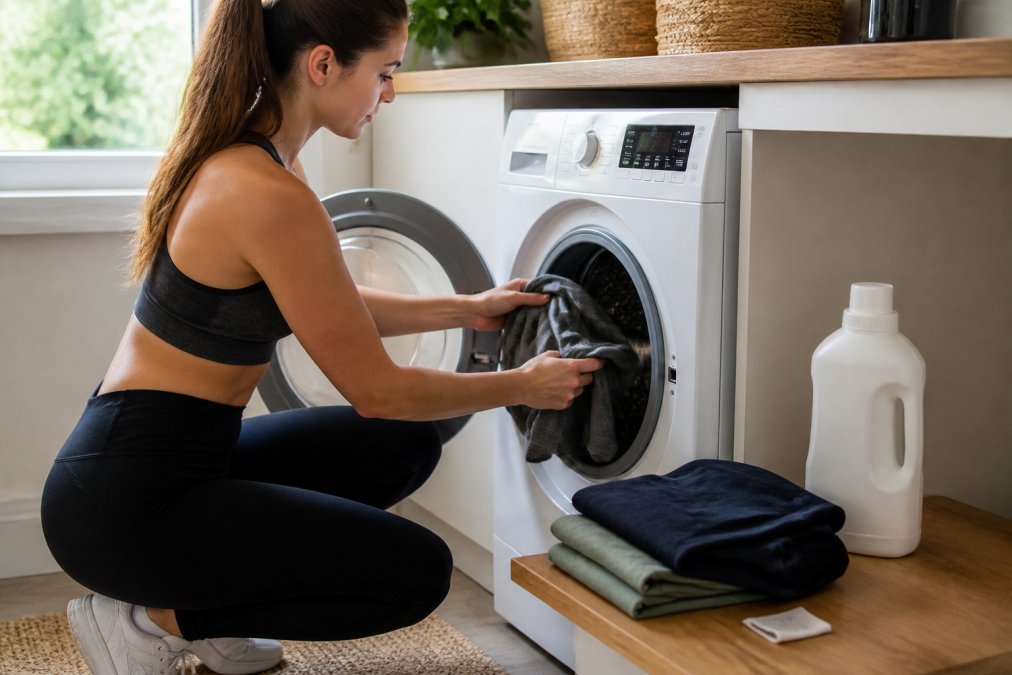
Step 1: Read the Care Label and Sort Your Load
Check the care label first, because it overrides general advice every time. Then sort by colour and fabric weight.
Keep heavy items like hoodies away from lightweight tees. Heavy fabric scrubs against lighter pieces in the drum and speeds up pilling. Wash gym clothes with similar weights together.
A practical rule: fill the drum no more than two-thirds full. Cramped loads can't agitate properly, so detergent and sweat residue stay trapped in the fibers. That residue is what feeds odour later.
Step 2: Choose the Right Cycle and Temperature
Set your machine to a delicate, hand-wash, or wool cycle with cold water, around 30°C or lower. Hot water causes shrinkage and fades dyes faster than anything else in your routine.
There is a genuine trade-off here that most guides skip. Cold water protects the fiber but is less effective at killing bacteria, which matters for gym gear. The workable compromise is a cold main wash paired with a warm (not hot) pre-rinse only when items are heavily soiled, or a laundry sanitiser added to the rinse cycle. Never push the main wash above 30°C for organic cotton, the shrinkage risk outweighs the sanitisation benefit.
Use a low spin speed, ideally 400 to 600 rpm.
Step 3: Dose Detergent Correctly and Skip Softener
Use about half the detergent you'd normally add for a full load. Too much detergent leaves residue in the fabric, which traps odour and makes clothes feel stiff.
Step 4: Dry Flat or Line Dry Away From Direct Sun
Lay knitwear flat or hang it on a line in the shade. Direct sun breaks down cotton fibers and dulls colour over repeated exposure.
| Step | Setting | Why It Matters |
|---|---|---|
| Sort | By colour and weight, drum two-thirds full | Prevents pilling, dye transfer and trapped residue |
| Wash | Cold (≤30°C), delicate or wool cycle | Reduces shrinkage and fading while protecting fibers |
| Spin | 400-600 rpm | Stops stretching and seam stress |
| Detergent | Half dose, enzyme-free | Avoids residue and fiber damage |
| Dry | Flat or line, shade | Protects fiber integrity and colour |
How to Remove Sweat Stains From Cotton
Sweat stains come from a reaction between aluminium in antiperspirant and your sweat, so treat them fast. The longer a stain sits, the harder it sets.
- Mix one tablespoon of white vinegar with one cup of cold water.
- Soak the stained area for 30 minutes.
- Rub gently with a soft brush, never scrub hard.
- Wash as normal on a cold, gentle cycle.
- Air dry and check the stain before it goes near heat.
How to Wash Gym Clothes to Remove Odour
Odour lives in trapped bacteria and detergent residue, not in the fabric itself. Fix both and the smell goes away.
Try this odour routine:
- Soak items in cold water with half a cup of white vinegar for 20 minutes.
- Wash on a gentle cycle with an enzyme-free detergent.
- Add half a cup of baking soda to the rinse cycle if odour persists.
- Air dry in open shade so airflow reaches every layer.
Best Eco-Friendly Laundry Detergent in Australia
The best eco-friendly detergent for organic cotton is enzyme-free, biodegradable, and free from optical brighteners. That is the short answer. The longer answer is about chemistry, because the wrong formula will quietly shorten the life of your activewear even if it looks clean.
Why enzymes are the problem
Enzymes are proteins that break down specific soils, proteases target protein stains, lipases target fats, amylases target starches. Organic cotton is a cellulose fiber, not a protein, so proteases do not dissolve the garment itself. The real risk is different: enzyme blends are formulated for heavy soil loads and often come paired with higher alkalinity and optical brighteners, and it is that combination, repeated alkaline washing plus brightener deposition, that dulls colour and stiffens natural fibers over time.
What to look for on the label
- Biodegradable and greywater-safe
- Enzyme-free or low-enzyme formula
- No optical brighteners or synthetic fragrance
- Concentrated so you use less per wash
- pH-neutral where stated, since alkaline formulas stress natural fibers
Australian shoppers can check a product's environmental claims against the Australian Competition and Consumer Commission guidance on green claims, which sets out what businesses can and cannot say about sustainability. Terms like "eco", "green" and "natural" are not regulated on their own, so the ACCC expects businesses to be able to substantiate specific claims.
Powder vs liquid
Powder formulas often skip the preservatives that liquid detergents need to stay stable in the bottle, which suits organic cotton well and tends to be cheaper per wash. The trade-off is that powder can leave residue if your machine runs a cold, short cycle, because it dissolves more slowly. If you wash cold, either pre-dissolve the powder in a cup of warm water first or choose a liquid concentrate.
Dose and temperature interaction
Detergent works within a temperature window. Most mainstream formulas are designed for 40°C and above, so at 30°C they underperform unless you compensate. Do not compensate by adding more detergent, that just leaves residue. Instead, use a formula designed for cold water, extend the wash cycle slightly, or pre-treat heavy areas.
Common Mistakes That Shrink and Age Organic Cotton
Most organic cotton activewear fails early because of heat and rough handling, not because the fabric was poor. Four mistakes cause most of the damage:
- Washing in hot water, which shrinks fibers and fades colour
- Using the tumble dryer, which causes the worst shrinkage and pilling
- Overdosing detergent, which leaves residue that traps odour
- Adding fabric softener, which blocks breathability and coats the fiber
Repair and Mending: Make Your Activewear Last Longer
Small repairs done early add months, sometimes years, to a garment's life. A loose seam or a small hole is a five-minute fix, but it becomes a bin job if you ignore it.
- Fix loose seams as soon as you spot them, before they split further.
- Patch small holes from the inside with a soft cotton patch.
- Reinforce stretched hems with a simple running stitch.
- Replace drawstrings and elastic before they fail completely.
Repairing instead of replacing also cuts textile waste.
Conclusion
Caring for organic cotton activewear comes down to cold water, gentle cycles, and air drying, which keeps your gear in shape far longer than any shortcut will. The hard part is staying consistent with it.
Frequently Asked Questions
Does organic cotton shrink in the wash?
Organic cotton can shrink if washed in hot water or tumble dried. Wash in cold water on a gentle cycle and air dry flat or on a line. This keeps the fibres relaxed and prevents the 3-5% shrinkage that typically happens with high heat. Always check the care label first.
Can I use fabric softener on organic cotton gym clothes?
No. Fabric softener coats the fibres and reduces breathability and moisture-wicking, which defeats the purpose of organic cotton activewear. It also traps odour-causing bacteria. Use a half-cup of white vinegar in the rinse cycle instead to soften fabric naturally and remove detergent residue.
How often should you wash organic cotton workout gear?
Wash after every one to two wears. If you sweat heavily, wash immediately to prevent odour and bacteria setting into the fibres. For light sessions, air the garment between wears. Frequent cold washes are gentler than letting sweat and oils break down the fabric over time.
Is it better to air dry or tumble dry organic cotton activewear?
Air dry whenever possible. Line drying or laying flat preserves fibre integrity, prevents shrinkage, and cuts energy use. If you must tumble dry, use the lowest heat setting and remove items while slightly damp. High heat breaks down the Lycra in stretch blends and causes organic cotton to lose its shape.
Washing organic cotton activewear properly is a habit, not a one-off task, and the payoff shows up in how your clothes look and feel after a year of training. Shred Cartel designs durable, certified organic performance gear built to survive that routine, with sweat-resistant materials and breathable comfort for the gym and beyond. Browse our collections and gear up for the long haul.